Milton Keynes · Buckinghamshire
Solar Panel Cleaning in Milton Keynes
Practical solar panel cleaning for homes and businesses across Milton Keynes. Not sure whether your panels need attention? Tell us what you can see and roughly how many panels you have.
Domestic panels, larger residential arrays and commercial solar installations, from an established estate in Bletchley to a warehouse roof beside the M1 corridor.
See when solar panel cleaning is worth considering before arranging the work.
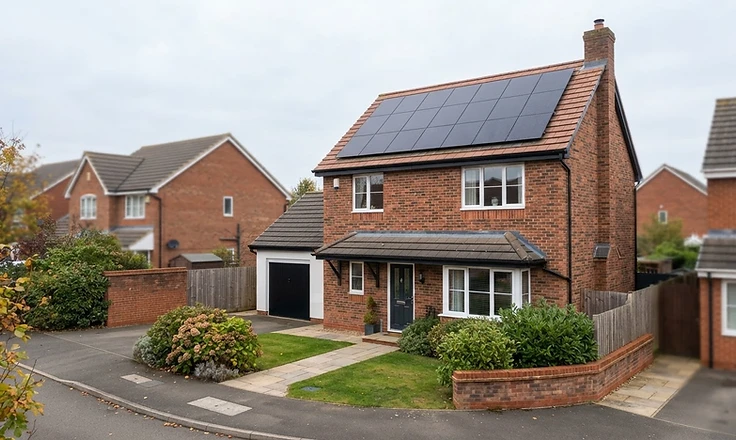
Residential · Commercial · Ground-mounted
MK Solar Care provides solar panel cleaning across Milton Keynes for domestic roofs, larger residential arrays and commercial installations. The approach is deliberately systematic: work out whether cleaning is a functional necessity for your array, then quote for it properly if it is. Whether you are on an established estate in Bletchley or a newer development in Whitehouse, that is the same conversation.
Solar panels in this part of Buckinghamshire sit in a wide range of situations. Some are on exposed roofs with a good pitch and clear sky above them, and those tend to look after themselves reasonably well. Others sit below mature trees, beneath roosting positions, on shallow pitches, or on broad commercial roofs beside busy service yards. Those are the arrays where surface contamination builds up and stays put.
Do your panels actually need cleaning?
Many solar panels receive a degree of natural cleaning from rainfall, and Milton Keynes gets enough of it that a good number of arrays look acceptable without any intervention. What rain handles badly is anything stubborn, sticky or concentrated. That is where cleaning starts to make sense.
Rain works best on a well-pitched, exposed roof, where water runs off quickly and carries loose dust and pollen with it. It works far less well on a shallow array, on glass shaded by trees, and on anything that has dried hard in warm weather. Bird mess is the clearest example: once baked on, it stays put through a British winter.
Visible dirt does not automatically mean the system is underperforming. Cleaning removes surface contamination. Whether this produces a noticeable generation difference depends on how dirty the panels were and the wider condition of the system.
Persistent bird mess
Droppings dry hard, land in concentrated patches and rarely wash off in the next shower.
Moss or organic growth at frame edges
Growth takes hold where water sits along the frames and spreads inwards over the glass.
Tree debris, sap and pollen
Overhanging branches drop leaves and sap, and shade keeps the surface damp for longer.
Traffic or industrial grime
A greasy film builds up near busier roads, service yards and industrial activity.
A shallow panel pitch
Water and contamination sit on a low-pitched array instead of draining away quickly.
Birds roosting directly above
A ridge, chimney, aerial or tall tree above the array means soiling keeps returning.
Agricultural or seasonal dust
Properties near open farmland on the city edges pick up seasonal residue and dust.
A long spell without effective rain
Light rain can leave deposits behind rather than clearing them, particularly in summer.
If none of the above applies to your property, cleaning may simply not be needed yet. Where several of them do, it is usually worth a look. Save the points that match your roof and they will be carried through to your enquiry, so you do not have to describe everything twice. You can also read the fuller checklist on Before You Decide.
When homeowners tend to enquire
These are the observations that usually prompt someone to look for a solar panel cleaner in Milton Keynes. They are all things you can see from the ground, which is exactly where you should be standing.
- 01Bird droppings across several panels rather than one isolated mark
- 02Panels visibly darker or dirtier than a neighbouring installation on the same street
- 03Moss accumulating near the frame edges and creeping onto the glass
- 04Debris collecting beneath or around the panels, or material poking out from underneath
- 05An array sitting below overhanging trees that drop leaves, sap and pollen
- 06A larger installation that has not been looked at since it was commissioned
- 07Obvious grime spread across a lower-pitched array that rain never seems to clear
One important exception: an unexpected loss of generation can have electrical or system causes that cleaning will not fix. If the readings have dropped while the glass still looks reasonably clean, the problem may sit with the inverter, the isolators, the cabling or a single string. That is covered on the solar panel maintenance page.
Cleaning and maintenance are two different jobs
People often use the words interchangeably, then pay for the wrong thing. The distinction is simple: cleaning deals with what is on top of the glass, and maintenance deals with the system underneath it.
Solar panel cleaning
- Removing surface contamination from panel glass
- Bird mess and other organic deposits
- Dust, pollen, traffic and industrial grime
- Moss and growth at frame edges where safely accessible
- Purified water and equipment suited to panel glass
System maintenance
- Inverter faults and error codes
- Cabling, isolators and switchgear
- Mounting systems and fixings
- Electrical testing and string checks
- System output analysis over time
MK Solar Care is a cleaning service. Electrical work is not carried out here. If the problem appears to involve the inverter, wiring or electrical output rather than surface contamination, the appropriate next step may be a qualified solar technician rather than cleaning.
Solar panel maintenance in Milton KeynesSolar panel cleaning for Milton Keynes homes
Most domestic arrays here run from eight to twenty panels across one or two roof slopes. What decides the method, and the price, is how the array can be reached.
The details that matter are the number of panels, the roof height, the pitch of the slope and whether anything sits underneath, such as a conservatory, a single-storey extension or a porch. Those features limit where equipment can be placed and how far back the elevation can be worked from.
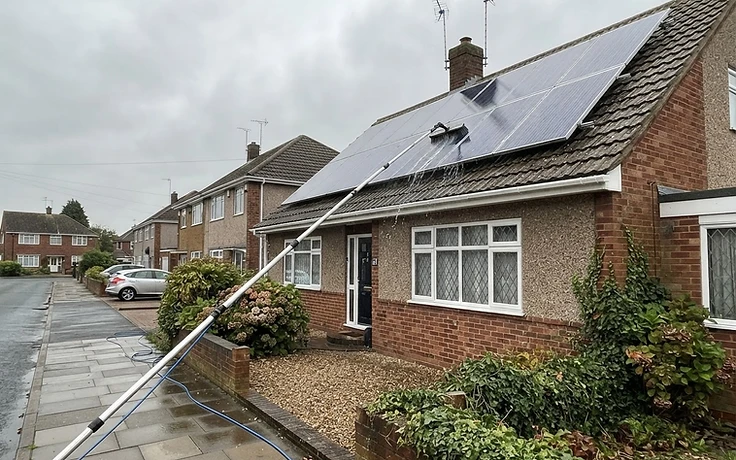
Where access allows, a water-fed pole system with purified water reaches the array from the ground. It is the cleanest approach for a domestic property because nobody has to be on the roof, there is no ladder leaning against the guttering and the panel surface is not walked on. Bungalows, garage-mounted arrays and many two-storey roofs are comfortable with this method.
Higher roofs, steep pitches and deep arrays that sit well up the slope may need suitable access equipment instead. Heavily soiled sections are given the time they need rather than being rushed through with the rest of the array.
Never climb onto your roof to inspect or clean your own solar panels. A photograph from the garden or pavement tells us what we need to know.


Commercial solar panel cleaning across the Milton Keynes hub
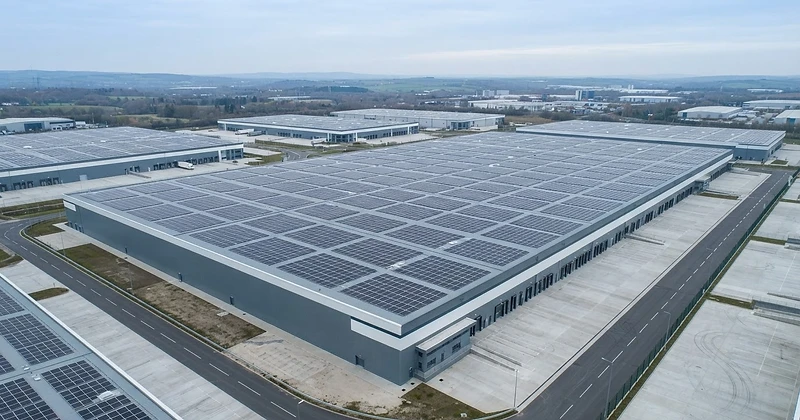
Milton Keynes is a cornerstone of UK logistics and holds a large amount of commercial roof space. Warehouses and distribution units, offices, schools and community buildings, retail premises and light industrial units have all taken on solar in volume, and those arrays are considerably larger than a domestic installation.
Commercial work is planned rather than simply booked. It usually involves more panels than a house roof, a considered access method, agreed safe working arrangements, and coordination around the way the site operates. Yard movements, delivery windows, shift patterns and school hours all shape when the work happens.
Where the roof cannot be reached from the ground with extended pole systems, options include mobile elevating work platforms, tower scaffold, or documented use of the building's own fixed access provision. Larger arrays can be phased across visits so the cost and the disruption stay predictable.
Buildings of this kind sit across the whole city: the business areas at Knowlhill and Linford Wood, the mixed office and industrial estates around Tongwell and Caldecotte, the logistics footprint near Magna Park and the M1 corridor, and the office stock in Central Milton Keynes. Those areas describe the type of premises served rather than any claim of completed work at them.
Quotations are built from panel count, array layout, roof height and pitch, the level of soiling and the access method required. Roof photographs, a panel schedule or a site plan make the process much quicker, and a site survey can be arranged where the array is large or the access is complicated.
Solar panels across a growing Milton Keynes
Milton Keynes is not one uniform suburb, and solar arrays here sit on very different kinds of building. That mix is the reason a single cleaning schedule applied to every property makes little sense.
Established estates and newer developments
The original New Town grid squares hold a great deal of housing, and some Milton Keynes estates have a long association with energy-conscious housing design, which is part of why retrofitted solar is so common here. Newer developments on the western and eastern edges, at Whitehouse, Fairfields, Brooklands and Broughton, often arrived with panels fitted from new.
Roof shapes differ accordingly. Newer builds tend to have consistent pitches and tidy arrays; older stock across the estates is more varied, with extensions, conservatories and dormers that change how an array can be reached.
Older towns absorbed into the city
Bletchley, Wolverton, Stony Stratford and Newport Pagnell were established places long before the New Town designation, and their housing reflects that. Mature street trees and older gardens are common, so homes in these areas are more likely to see pollen, leaf debris, sap and bird activity around the array.
Villages and quieter areas such as Loughton, Bradwell, Shenley, Great Linford and Wavendon sit somewhere in between, with a mixture of open plots and heavier tree cover from one street to the next.
Commercial and logistics areas
Large commercial roofs behave differently to domestic slopes. Water drains slowly across a broad low-pitched roof, so general grime spreads more evenly and settles along the lower edge of each module. Roofs near yard traffic, loading operations or construction activity tend to accumulate a heavier film.
Ground-mounted arrays on rural and commercial land around the city edges add another pattern again, with soil splash and vegetation gathering along the lowest row of panels.
Service area
Bletchley · Wolverton · Stony Stratford · Newport Pagnell · Shenley · Tattenhoe · Westcroft · Broughton · Brooklands · Wavendon · Monkston · Kents Hill · Walnut Tree · Great Linford · Loughton · Bradwell · Whitehouse · Fairfields and the wider Milton Keynes area, including surrounding villages and rural properties within reasonable reach of the city.
What affects solar panel cleaning cost?
No fixed prices are published here, because a genuine figure depends on the property. What follows is the list of things that actually move the number, so you can see where your own array sits.
01
Number of panels
The single biggest factor on both a house roof and a commercial array.
02
Roof height
A bungalow, a two-storey house and a three-storey townhouse are three different jobs.
03
Roof or array pitch
A shallow pitch holds contamination longer and can be harder to reach from the ground.
04
Access
Whether a water-fed pole reaches the array, or access equipment is needed instead.
05
Panel layout
A single tidy block is quicker than panels split across several slopes or elevations.
06
Degree of soiling
Light dust, a general film and baked-on deposits all take different amounts of time.
07
Bird mess
Concentrated droppings need dwell time and repeated passes rather than force.
08
What sits beneath
Conservatories, extensions and porches limit where equipment can be placed.
09
Commercial requirements
Permits, inductions, cordoning and out-of-hours working all affect the quote.
10
Mounting type
Ground-mounted arrays are safer to reach but are often much larger.
Photographs help a great deal with an initial figure. A wide shot showing the whole roof and array, plus a closer shot of any staining or bird mess, is normally enough to judge panel count, access and the level of soiling before anyone visits. For commercial sites, roof photographs, a panel schedule or a site plan serve the same purpose.
Before you decide
Cleaning is worth arranging when there is a clear reason for it. This is the short version of the questions worth working through first, so that you are not paying for a visit that will not change anything.
Read Before You Decide- Do my panels actually need cleaning?
- Could the problem be electrical instead?
- Can rainfall clean solar panels?
- Is the bird mess concentrated enough to justify cleaning?
- Can the panels be reached safely from ground level?
- Is this a cleaning issue or a solar maintenance issue?
- Is regular scheduled cleaning worthwhile for this property?
Solar cleaning services in Milton Keynes
Residential Solar Panel Cleaning
Household arrays cleaned from ground level where access allows, across Milton Keynes estates and villages.
Read moreCommercial Solar Panel Cleaning
Warehouse, office, school and industrial roof arrays, with access planning and scheduled options.
Read moreSolar Panel Maintenance
Understanding the line between surface cleaning and electrical or system faults.
Read moreBird Mess & Heavy Soiling
Concentrated bird droppings, nesting activity nearby and repeated organic contamination.
Read moreRegular Solar Panel Cleaning
Recurring visits set by site conditions rather than a fixed universal schedule.
Read moreGround-Mounted Solar Panel Cleaning
Field and yard arrays where access is simpler but the array is often much larger.
Read moreCommon questions
[MK-SC-ENQUIRY]
Tell us what you can see
Send the approximate number of panels, the postcode and a photograph if you have one. We will tell you whether cleaning looks worthwhile.